• Skip to main content
  • Skip to secondary navigation
  • Skip to primary sidebar
  • Skip to footer

Comics for Beginners

How to Write & Draw Comics

  • Contact
  • About
  • Faqs
  • Log In
  • Resources
  • Podcasts
  • Comics Crash Course
  • Blog
  • Videos

Pro Tips

Are You Good Enough for a Career in Comics?

by Palle Schmidt 2 Comments

good-enough

We all look for approval, as people as well as artists. We want to be told we are great, that everything will work out for us. The truth is, no one can really give us that validation.

We might get lucky and meet some peers who can give us guidance, tell us where we need to improve or tell us not to worry so much. But we all worry. And I bet you we all ask the same question: Am I good enough? Do I have what it takes to make it as a comics artist?

No one can tell you for certain, if you have what it takes. A portfolio review only tells you if you have the basic talent for drawing. What goes on inside of you is far more important. Are you willing to put in the time and effort to get to the level you want? To confront your own shortcomings and tackle them head on? Are you prepared for the insecure lifestyle of a comic book artist? The solitude? The long hours? The lack of money and lack of respect from your friends and family?

Are you ready for critizism, fair and unfair? Can you muster up the guts to consistently put yourself out there and be judged? How do you handle taking notes and being told what to do? Do you freeze up when you have to perform under less-than-optimal circumstances? How well do you work under the pressure of a deadline? Do you get anything done if there’s NO deadline, or do you end up wasting your days playing World of Warcraft? Can you forgive yourself for producing less-than-perfect art? Do you endlessly beat yourself up if you’re not productive enough, good enough or succesful enough?

What does “making it” even mean for you?

Have you set a specific and measurable goal, and if not, how will you know if you get there? And have you set a time limit for when you want to have “made it”, knowing that it will probably take years longer than you expect?

And guess what – no one has ever “made it” in comics. Because you’re only as good as your last job. Because even the artist you admire the most judge their own success in a totally different way than you do. Because no matter how succesful you are, you still strive for more. There’s always room for improvement.

All this may sound like I’m trying to get you to give up, which is not at all true. The only thing I want you to give up, is asking the wrong questions. Whether you are good enough, time will tell. Time, effort, courage, persistance.

And you know when you are “making it”?

When you are making the most of the skills you have.
Filed Under: Pro Tips Tagged With: career, comics industry, creativity, deadlines, fear, improving as an artist, learning, mind hacks, mindset, planning, pro tips, procrastination, productivity, success, World of Warcraft, writer's block

Bonus Video: Choose Your Own Adventure

by Palle Schmidt 6 Comments

Time to make some tough choices!

As an artist you often have more ideas than you have the time and resources to complete. How do you decide what projects to do next? How do you make sure you’re not just mindlessly taking on all incoming work but stay true to your creative vision? Is strategy even a word in the artist dictionary? And what does a walk in the woods have to do with making comics? Watch the video to find out!

Let me know if this video helps you in any way or what method you use to decide what to work on. Do you even have a method or do you just follow your gut?

Filed Under: Pro Tips, Video Tagged With: career, comics, creativity, learning, planning, pro tips, strategy, work for hire, writer's block, Writing

The Cost of Feeling Inspired

by Palle Schmidt 8 Comments

Something I’ve been thinking about lately, is how much we as artists (in whatever media or form we work in) are dependent on our own mood and mindset to be prolific or even just get a little something done. Call it tenacity or grit or simply lying self talk that allows for us to continue working on something that the rest of the world deems useless. But what if you’re just not feeling inspired?
Here’s the thing: Inspiration is rare. It’s fleeting. You can’t sit around waiting for it, you’ll end up waiting forever!
So here is a list of things you may find helpful, to avoid having to rely on inspiration to be the driving force of your work:
Habit and routine
I have a studio space about a 15 minute bike ride from my house. So every day pretty much without fail, after I drop off my kids to school I just keep going. I’m already up and dressed and halfway to work. Well not quite, but you get the idea. The idea is this: I don’t have to debate myself of whether to stay in and watch Netflix or get to work. I just go. And having other people at the studio makes me feel slightly guilty for the occasional day off, I’m sure that is a factor as well.
Allocated time
And it needs to be time enough to actually make a dent in the work. This depends on the type of work of course. If I only have a few hours, there’s no way I’m going to get any writing done on that novel. I’ll just mindlessly scroll through the document, correct a spelling here or there but it doesn’t feel like progress. For me, I’m probably better off not even opening the document at all, since it always tend to leave me feeling like a s**tty writer.
Deadlines
The best thing you can do to make sure you have exactly the right time for the work, is for someone else to decide when they need it. You know of Parkinson’s Law? Basically it’s like this: “Work expands so as to fill the time available for its completion”. So if you have a week to do something, that’s how long it will take. If you have a day however, you could probably do it in a day, whatever “it” is. Deadlines are a great way to beat the feeling like you need to be inspired, because you simply don’t have the time to sit around and wait for it.
Preparation
I can easily sit down and sketch a few pages if I already know what’s going to be happening on them, if I already made thumbnails or roughs. A blank page and no script? Not so easy. So mental preparation is in order. The same goes for tools of course. If you spend the first half hour looking for stuff you need and getting the canvas ready, there’s less time to do the actual work. As described in this post, the best productivity hack I can give you is decide the day before what to work on, so you can jump right in.
Shut up your inner critic
You know that voice in our head that tells us it’s a piece of crap we’re working on, that nobody would want it, it’s a waste of time? Yeah, not really helping, is it? Steven Pressfield calls it The Resistance, an almost metaphysical force trying to stop us from what we want and need to do. I sometimes manage to shut that voice up by listening to the same soundtrack over and over. Like telling my brain we are in work mode. I’ve also recently found that Synthwave really put’s me in the zone and makes me keep moving. If I’m drawing, I listen to audiobooks or podcasts, mostly to battle my anxiety/boredom/need-to-check-my-email-or-Facebook-every-5-minutes.
I’d love to know what works for you! Leave a comment below.

Filed Under: Pro Tips Tagged With: creativity, habits, inspiration, mind hacks, pro tips, productivity, routines, tips for making comics, workflow

Step-by-Step Guide: My Comics Process

by Palle Schmidt 6 Comments

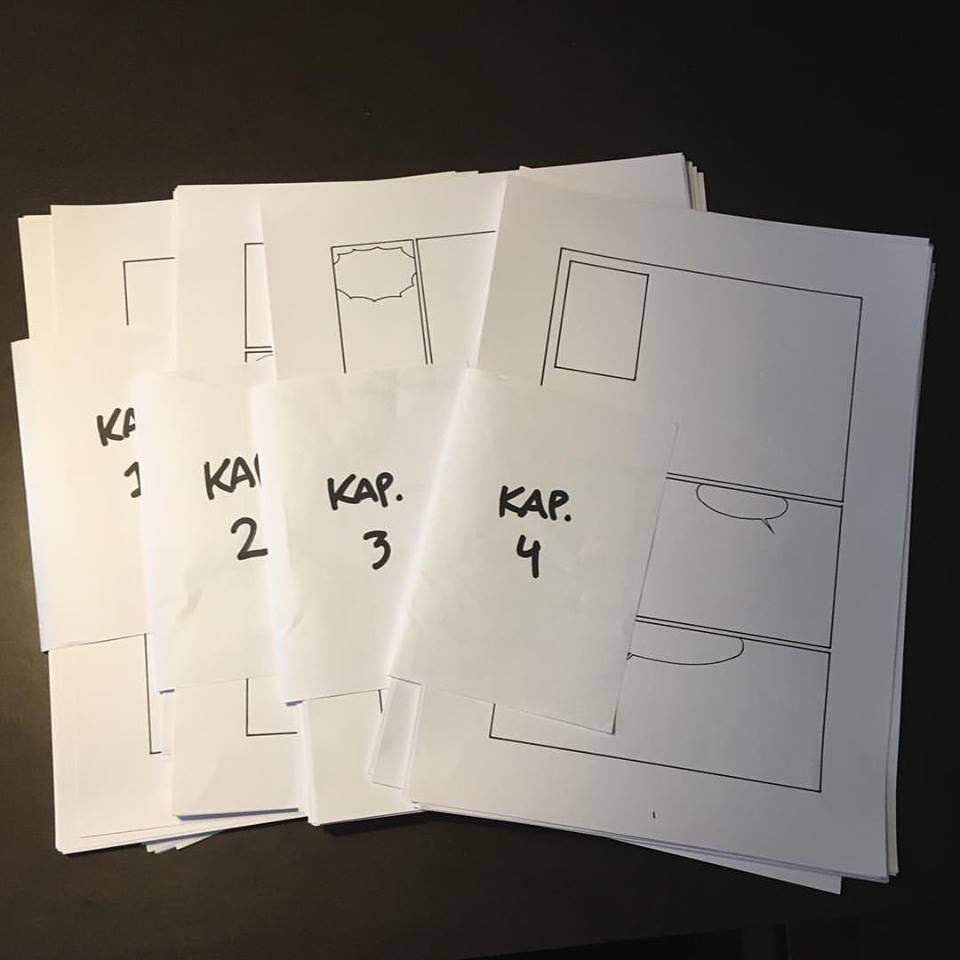
This is my next graphic novel project! Filling in the blanks should be no biggie, right? Well, there’s a little more to it than that.

I recently posted this picture on Instagram and Facebook that got a lot of likes – and a lot of questions! So I thought I’d elaborate a bit on how I actually tackle the creation of a comic or graphic novel. I go into detail with certain elements in my premium 10-video tutorial series, but these are the basic steps I go through every time.
1: Script

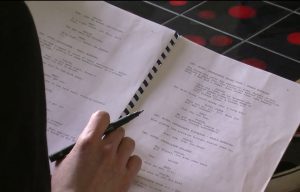
Having a finished script before you start drawing increases your chance of actually finishing with about 3000 percent. The first 2 videos of the premium series covers this (and those episodes are free). Sometimes I’ll get a script from another writer but I often work off my own or have to break the story down into pages.

2: Thumbnails

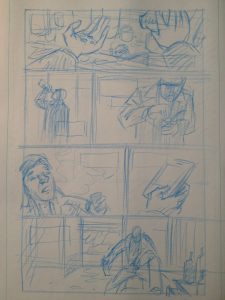
This is little scribbles just to get a grip of the page breakdowns. I don’t neccesarily do it for every page but it can be very helpful. The more I plan before I start drawing, the more smoothly the rest of the process. There is a podcast episode about making those hard choices here.

3: Rough sketches

Once I know sort of what the layout of the page will look like, I can start rough sketching pictures. As you’ll notice, this is bare bones storytelling, just enough for others to make out what is going on. No more, no less. I usually sketch on half pages, not full size. No need for bigger format when I’m not doing details – in fact the smaller format often helps in creating a clear layout.

4: Borders and lettering

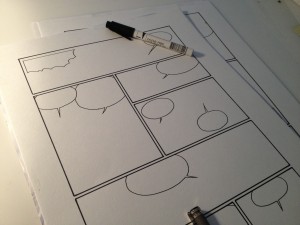
After scanning my rough sketches, I put them in an InDesign document. If it’s an issue of a comic, I’ll make seperate 22-page files that stick to the same template. I’ll start by creating a standard border for the entire project and just plunk that in between all the frames. Then I’ll put the lettering in where it needs to go. Please note, that this is not the final document! I can adjust the lettering once I have the finished art. For full breakdown of this process go here.

5: Borders and balloons

Using a print-out of my now lettered rough sketches, I am ready to draw the actual pages. BUT, since I might need my borders and speech balloons in a clean format, I do the boring work of inking that part first. This is what the image I posted on Instagram portrayed – I can see why there was some confusion as to how I actually worked!

After I’ve traced the borders and balloons on the board I intend to do the rest of the artwork on, I scan the whole thing. Why? I’ll explain in step #8.

6: Sketching

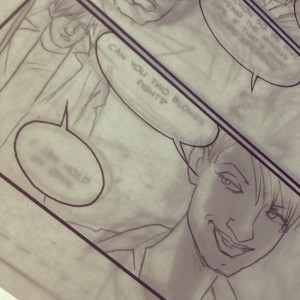
Using my rough sketches as a guide, I’ll sketch the pages going into more detail, especially on backgrounds and stuff. A picture might change from my original ideas, but I always stick within the frames I already decided on. There’s a video of that process here.

7: Inking

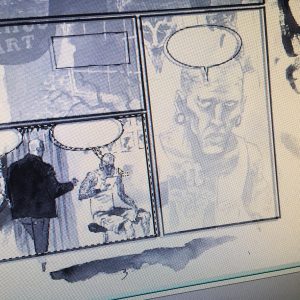
Using a lightbox I trace my skectched pages on the boards that already has the borders and balloons. I can adjust the images a bit if needed. Sometimes I do painted art and other times I ink with black markers. There’s a video of me inking a page of Thomas Alsop here.

I don’t need to worry about paiting outside the borders in this stage because I’ve already scanned the clean pages with just balloons and borders, and no art.

8: Scanning and clean-up.

Remember when I said I might need the borders clean? This is the step. I used to I scan my inked pages and clean up mistakes where I painted outside the frames or over speech balloons. Now I just use the already scanned borders. I just smack my clean borders over the finished art in Photoshop, turn the opacity down a bit so I can see what I’m doing and adjust the corners. It took me a while to figure this out, because sometimes a scanner will skew things a little bit. But I discovered that if I do a “free transform” and focus on the four outer corners of the borders, the rest will sort itself out.

Once the two layers match up, I’ll select all the white within the frames on the top layer and delete that. Then I turn the opacity of the layer back up to 100% and viola! I now have a layer with nice, clean borders and balloons on top, and whatever mistakes (painting outside the borders) I made are hidden underneath. I flatten the file and export it, usually as a high-res tiff file.

8.1: Coloring (optional)

I’m not gonna go into detail here, but you might want to check out this post on coloring in Photoshop.

9: Repeal and replace!

Admitted, I don’t really call it that. But I do have to go through my already lettered InDesign file and delete all the border blocks and replace my rough sketch with the finished art. Some adjusting to the lettering is usually neccesary but then I have the entire book or issue ready to send to the graphic designer or export as a PDF directly for print.

10: Celebrate

I usually skip this step, honestly. But having typed up this post and seeing how much work goes into creating a graphic novel, I feel like I should make a point of this going forward.

Hopefully this answered some of your questions and gave you a few ideas to implement in your own process. Please share this post if you found it helpful!


Filed Under: Pro Tips Tagged With: A. J. Kazinski, art hacks, Art Tutorial, balloons, borders, comics, creativity, graphic novel, how to, inking, making comics, mistakes, painting, Photoshop, planning, pro tips, process, sketching, speech balloons, storytelling, Thomas Alsop, tips for making comics, workflow

One Item To-do List

by Palle Schmidt 2 Comments

I don’t know about you, but I have a to-do list about a mile long. And however many things I check off the list, I never seem to get to the bottom.
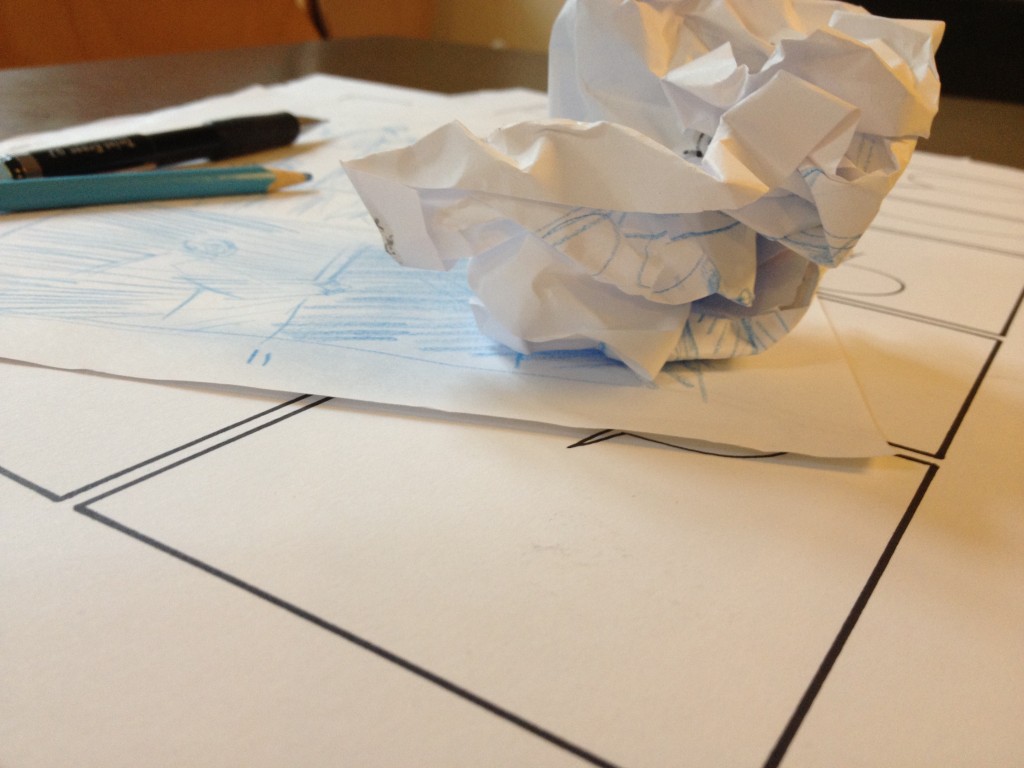
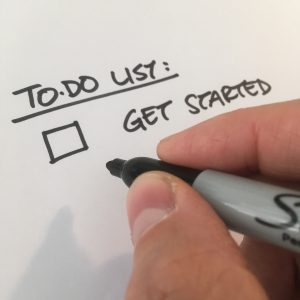
That’s why I’ve decided to try out a new approach. A to-do list with just one thing on it: Get started.

You see, procrastination is something that usually kicks in before you even sit down to work on whatever you should be working on. Once I get started, I normally keep going until I have to go pick up my kids or cook dinner. I find that the resistance comes when there are too many choices, too many conflicting tasks.

If you want to get in shape, I sincerely doubt that a complex workout plan is not going to be helpful. You want to make it easy for yourself, get some momentum going. Set a tiny goal like just get on the treadmill every day. Just get on it. And what are you going to do, just stand there? Might as well start moving.

And just as a disclaimer; I don’t know anything about getting in shape. I’m not and never have been in any particularly good shape. That’s not the point. It’s the principle of just getting started and not setting too ambitious goals or have a thousand items on your to-do list. Maybe you just need the one checkbox.

Want more productivity tips? Try giving this podcast episode a listen.

Filed Under: News, Pro Tips Tagged With: art hacks, career, creativity, making comics, mind hacks, pro tip, productivity, tips for making comics, to-do list, workflow, writer's block

Choose The Right Inking Style

by Palle Schmidt 2 Comments


Some say there are only seven different stories in the world. That may be true. But there are a million different ways to tell your story!

In comics, probably the most important part of the storytelling, is the style you choose in the drawing. A lot of black on the page tends to attract an older audience, while a slick, curved line art and big eyes on the characters will give off a more Manga-like feel. There is a huge difference between a character sketched rendered in scratchy-scratchy detail like a Burns or a Crumb and a drawing inked in flat blacks like a Mignola or a Miller.

First off you have to decide what the genre of the story is. Maybe your style itself fits a certain genre, maybe you are able to change up your style to fit the genre. Whatever the case,you need to make a conscious decision.

My advice would be to look at other comics in the genre and see how they do it. The danger is that you may get too influenced by a certain style or artist, so having more than one reference is always a good idea!

Most artist have what I would call “riffs”. A certain way of drawing something, usually a short cut of sorts. You pick up riffs along the way, but you also invent your own. Your hand will do most of the hard work, but you can also conciously decide to use a certain inking style on a project.

The most important thing about style and tone, is consistency. A set of dogma rules for yourself before you start drawing a particular story can be a good idea. Choose the tools and riffs you will use and stick to that. Do short stories and try out different techniques, see what works for you. And what it does for the story! You can do it in a million different ways – the key to succesful storytelling is to pick a way and stick to your decision.

Filed Under: Pro Tips Tagged With: drawing, inking, inking style, making comics, productivity, style

  • « Go to Previous Page
  • Page 1
  • Page 2
  • Page 3
  • Page 4
  • Interim pages omitted …
  • Page 17
  • Go to Next Page »

Primary Sidebar

Hours of Premium Content

ComicsCrashCourse

Try the FREE 7-day Comics Course

Creator Profiles

Interviews with Creators

The CFB Podcasts

Find them here.

Comic Creators eBook

The Comic Creators eBook

Footer

Check out more resources

Bundles of quality content available, check how to write comics and how to make your comic book artwork look great or find tips and tricks on the blog.

Latest from the blog

  • Video: How to get Story Ideas
  • Video: The Benefit of Being a Nobody
  • Video: Why Creatives Hear Voices
  • Digital Tools for 2021
  • The Most Badass Tools for Inking Comics
  • Why Creative Restrictions are Good for You!
  • How to Write a Great Story – and Stick the Landing

Contact us

If you have questions or issues please contact us.

Official mail: mail(at)comicsforbeginners.com

Feel free to connect on Twitter and/or Facebook.

Copyright © 2026 · ComicsForBeginners by Palle Schmidt Log in