• Skip to main content
  • Skip to secondary navigation
  • Skip to primary sidebar
  • Skip to footer

Comics for Beginners

How to Write & Draw Comics

  • Contact
  • About
  • Faqs
  • Log In
  • Resources
  • Podcasts
  • Comics Crash Course
  • Blog
  • Videos

News

How to Write a Great Story – and Stick the Landing

by Palle Schmidt Leave a Comment

So you’ve read all the books on writing, from Syd Field to Scott McCloud and you still struggle with writing a compelling story. Nothing seems to work or hold your interest long enough to get the damn thing finished!

It sounds to me like you’ve been looking for inspiration in the wrong places. Books on storytelling can be great to help you course-correct but rarely feed the creative fire to create something from scratch. You need to turn your looks to your inner self, what stories are bubbling in there that you want to tell? Or read lots of fiction to get inspired for your own stories.

I certainly can relate to jumping from one story to the other, I do it all the time (see this post on writing for scatterbrains: https://comicsforbeginners.com/writing-tips-scatterbrains/). The main difference I think is I have enough discipline and/or experience to either abandon a story with total conviction (after not spending too long on it) or clench my teeth and finish the damn thing at some point.

A friend of mine who’s a very succesful and wildly productive writer once told me: “He who has written is wiser than the one who has not.” Meaning you DO learn and evolve, even though you may end up scrapping the ten pages you just wrote. My friend also suggest keeping all the failed attempts and false starts on file because who knows? Maybe one day that bad idea can be used as a subplot for another story, a character you wrote can be brought back from the dead to play a part in something else, or you will simply get a new idea from skimming through an old one. I personally just found a document I had forgotten I wrote, which turned out to be a pretty decent outline for a crime story that never really found it’s form. Looking at it now it seems perfect to pitch to this new editor I just had a meeting with.

Not everything has to pay off here and now. You can plant seeds and maybe one day some of it will bear fruit. Be patient.

That said, you need to finish something to build your confidence as a storyteller. Every abandoned project that just didn’t work or you lost interest in will add another frustrating chip in your armour, make you feel like a loser. I harp on this a lot, the fact that quitting half way through a project breaks down our self-confidence as creators – and we NEED that self-confidence, it’s at the core of our creative existence. We need to nourish it and shelter in from the slings and arrows of outrageous fortune as Shakespeare put it, keep it safe from the nay-sayers and the sceptics, because they will stomp that thing into oblivion if you let them.

I recorded a podcast episode on quitting that might be helpful: https://comicsforbeginners.com/comics-for-beginners-podcast-episode-30-why-we-quit/

Again, there is the possibility you just don’t have a knack for writing. And that’s totally OK! You can work with a writer or a writing partner (which might also help keep you on track and accountable). I wrote a post on getting an artist on board. If you flip the narrative, you might find some good ideas here: https://comicsforbeginners.com/catch-artist/

Choosing which story to pursue is not easy. Decide early on to ditch the idea or stick the landing. If you find yourself returning to a story again and again in your mind, then it’s time to commit to develop it further. Set a deadline, get an accountability buddy who agrees to read your first draft.

My final piece of advice would be to spend a day or two writing up a synopsis or just notes on a story, then leave it be for a week or more. If you keep returning to the story and characters in your mind, that’s an indication there’s more to explore in that world. If you don’t dream or think about the story at all, doesn’t mean it’s not a good idea – it just means you are not meant to write it.

Filed Under: News Tagged With: characters, commitment, finishing, workflow, working methods, writer's block, Writing, writing for comics

Coloring in Photoshop – 5 Steps for the Absolute Beginner

by Palle Schmidt Leave a Comment

Make sure your line art is in a separate layer from your colors!

Digital coloring can be just as elaborate and detailed as an oil painting. But if you’re just getting started, here is a simple step-by-step guide for getting ready to color your comics in Photoshop.


Step # 1: Scan your line art.

I would recommend scanning in Grayscale and converting to Bitmap after. The resolution should be at least 300 dpi (dots per inch), maybe even 600 dpi. I would also recommend converting your line art to bitmap before you start working on it, to make sure the lines are crisp and clean.

Step # 2: Grayscale to RGB

I know I just told you to convert your line art to Bitmap – But in order to start coloring, you need to convert it back to grayscale, before you can convert it to RGB.

Step # 3: Copy your background layer

Making a copy of your line art layer is a good precaution, in case you screw something up. Click the visibilty of the original layer off and set the layer mode of the copy to “multiply”. This basically transforms your line art layer to the equivalent of clear plastic film that you put on top of your color layer.

Step # 4: Color layer(s)

Make a new layer in “Normal” mode, and make sure to place it under your line art layer.

Step # 5: Start coloring!

That’s it! No more steps really, unless you want to get creative – which you should! But this post is meant to just get you started, so these 5 steps are all you need to know for now, except this:

Bonus step: Save, flatten, save again.

When you have finished coloring your page (and along the way, just to be sure) save your work as a Photoshop file, so you have a back up including all the layers.

Then go to the “layers” menu and click “flatten image”.

If you intend for your comic to be printed, convert the color mode to CMYK and save it as a Tiff file. If it’s for web use or an inkjet printer, keep it in RGB and save it as a Jpeg.

Related post: Tips for Digital Coloring

Filed Under: News Tagged With: artwork, bitmap, cmyk, coloring, digital painting, how to, layers, Photoshop, rgb, tiff, tips for making comics, workflow

Video: Creativity Everywhere

by Palle Schmidt Leave a Comment

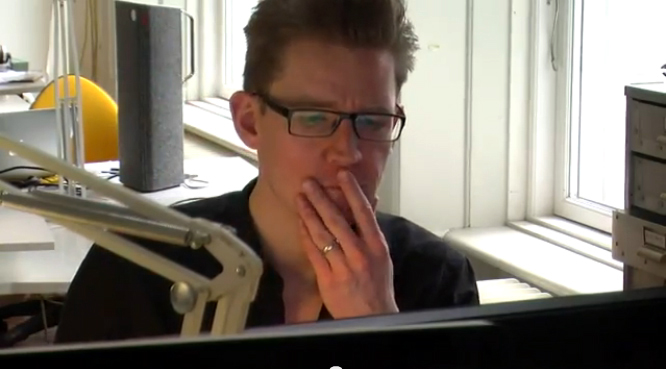
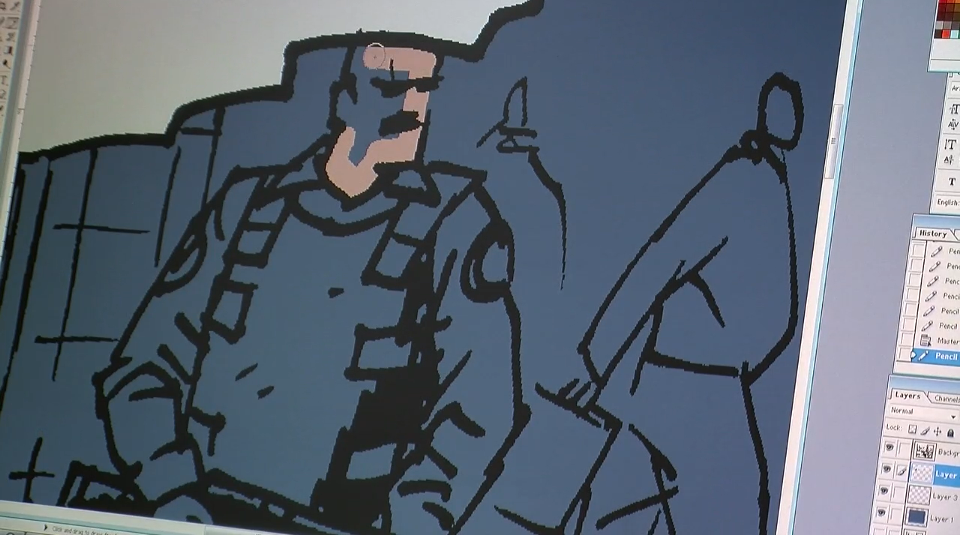
I was asked to participate in the Creativity Everywhere series on YouTube and talk about my creative process. Click below to see me break down how I work on a comics page, using a page from STILETTO as a concrete example.

On another note; While the pandemic is still affecting people globally I’ve discounted the premium comics course at $5. Go here to claim lifetime access.

Filed Under: News Tagged With: comics, comics craft, creative decisions, creativity, drawing, how to make comics, STILETTO, video, YouTube

The Art of Being an Artist

by Palle Schmidt Leave a Comment

Your first year or two as a creative freelancer the focus should be to build your boat and get in the water. When you’re afloat and not taking in water, you can start to think about your destination. Where would you like to go?

To many people, art is a hobby. But it’s when you really start to take it seriously and treat it as your job that you really pivot. William Faulkner is quoted of saying: “I only write when inspiration strikes. Fortunately it strikes at nine every morning.”

Showing up at your desk is when things start to happen. The more you show up, the more likely it is that you’ll create something of value. You have to put in the hours, consistently. Painting a couple of times a month won’t make you a great painter. You have to build momentum and consistency and daily routines is key.

You can have a somewhat mediocre talent and still have a great artistic career. Just as you can be insanely talented and still struggle making it work. It’s not about talent as much as it is about courage, persistence and resilience.

Keeping your ego in check is another important aspect. You need some ego to find the belief the song you wrote is so great that everybody needs to hear it. But that ego can just as easily trip you up, if you start to think people don’t appreciate your genius enough. Or you strive for perfection in your work, feeling like it’s never as good on the paper as it was in your head (hint: It isn’t. This feeling never goes away, believe me!).

As an artist you expose yourself a lot and have to be willing to take criticism. You have to push yourself, and not hold back out of fear of what people might say. You have to be okay with shipping something you’re not a hundred percent satisfied with – chances are you never will be.

In 2011 I sat for a few weeks at Dean Haspiel’s Hang Dai Studios in Brooklyn. One of the guys at the studio asked for Dean’s advice on whether to take on a particular storyboarding job. He was worried he would fall short and botch the job somehow. Dean replied: “You need the money? Then you take the job. And you fail. HARD. And you learn from that”. That attitude was truly inspiring; expecting to fail and being okay with it. I certainly learned a lot from my brief spell at Hang Dai but also from taking on tasks I wasn’t entirely ready for. 

One of the things I hear tossed around a lot, is the idea that you’re only as good as your last work. I disagree. You are the sum of all your creative outputs, good or bad. And you’re not always the best judge of quality – in fact you’re likely the worst. You just have to do the best you can at that moment and get it out there. You don’t end up back at square one because some project didn’t turned out the way you wanted it. In fact you learn more from a project like that than you do from a smooth success.

When the process is grueling, frustrating and hard, it’s likely because you’re evolving and growing as an artist. When you reach that plateau and it feels like you’re never going to get better, when you feel like quitting – that’s exactly when you need to push through.

If you want to learn to swim, you have to go in the deep end of the pool.


This post is an excerpt from my book SOLO – Survival Guide for Creative Freelancers – Order now on Amazon.

Filed Under: News Tagged With: career, comfort zone, daily habits, ego, freelance life, improving as an artist, mindset, productivity, SOLO, solopreneur, workflow

Scare Away the Clients

by Palle Schmidt Leave a Comment

An advanced technique if you have too much incoming work (or just want to test your own limits) is jacking up the price. Just think of what the fair price would be and add thirty percent. If this makes the client run away screaming, great! On less item on your plate. If they accept your shameless price, great! More money for you, and more motivation to move things around in your calendar and put in the extra effort.

I usually give the high price first, being willing to go down, if I meet resistance. You can steal this tactic:

“My going rate for something like this would normally be around (insert high amount)…”

Take a moment. Sometimes the client will jump in going: “That sounds reasonably.” Boom! No need to negotiate further.

If, on the other hand, your hear them fall of the chair on the other end of the line, you can pick up your thought:

“…but since (it’s you/ it’s part of a larger project/ it sounds like a relatively simple task) I’m sure we can work out (a discount/ lower rate/some sort of bundle deal). How about (insert lower amount)?”

Pricing is all about supply and demand. I’m sure you can find plenty of people willing to undercut you. I mean, you can get a freelancer to do almost everything for $5 on Fiverr.com! You do not want to think of that segment as your competition. 

If your unique expression is what the client is looking for, price matters a lot less. They’re paying for you, for your personality and the experience you bring to the table. If a client mentions that they can get the same thing cheaper elsewhere, I’d recommend you simply agree with them and perhaps even direct them to some of your lower paid colleagues. 

What you offer as a professional is something other than bargain prices, it’s industry experience and a unique skill set. If you speak the same language as the client, culturally as well as professionally, you are great at what you do, flexible and accommodating, understanding of your clients needs – those are reassuring qualities worth paying premium for. Especially if you go the extra mile in terms of showing up in person for a briefing, getting on the phone instead of hiding behind e-mail. 

Deliver on your promises every time and the clients will keep coming back – even if some graphic designer in Bangladesh can do the same thing at a tenth of your rate.


This post is an excerpt from my book SOLO – Survival Guide for Creative Freelancers – Order now on Amazon.

Filed Under: News Tagged With: business hacks, comics business, dealing with clients, freelance, freelance life, negotiation, pricing, pro tips, process, SOLO, work for hire

Ask the Right Questions

by Palle Schmidt 4 Comments

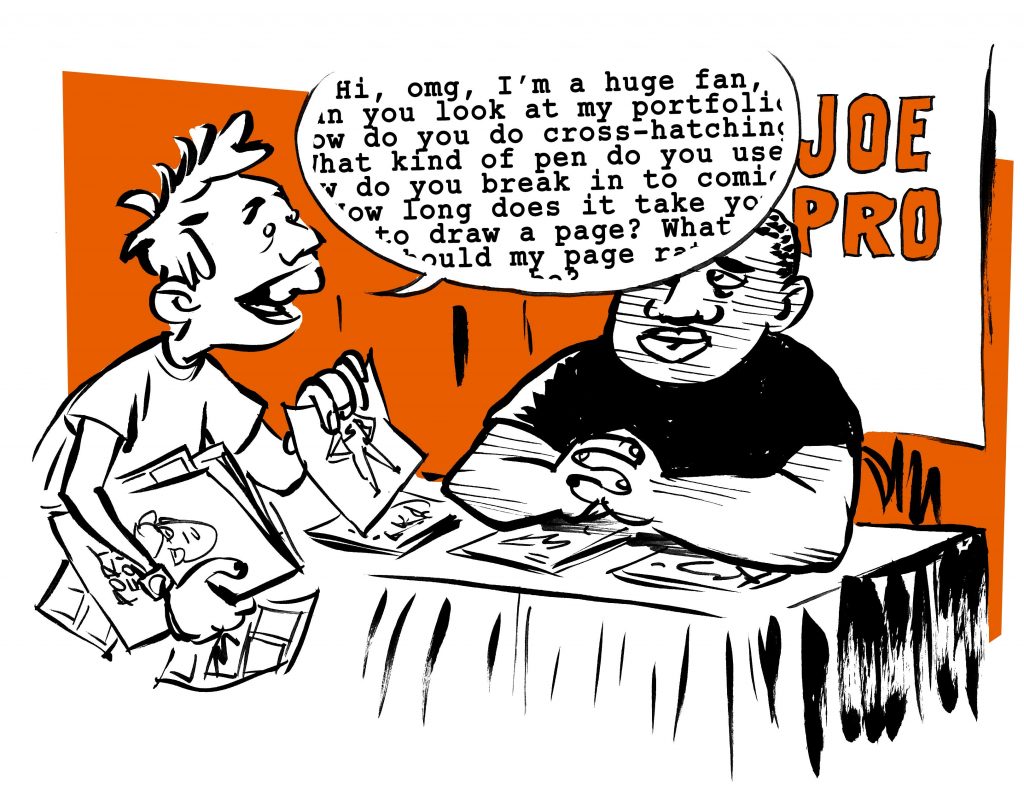
Going to conventions is one of the best way to learn about the industry, meet new people and get advice from peers and pros. But often wannabe creators will waste the opportunity to learn by talking about themselves or asking the wrong questions.

“How do I break into comics?” is one of the questions I hear a lot by aspiring creators. The question is not easy to answer in a meaningful manner – and it certainly won’t be a short answer (my best and shortest possible answer is this podcast episode). It also requires a lot of background information on the person asking the question.
When not asking impossible questions like the one above, these creators will try and impress whoever they are talking to, pitch their comics ideas, tell rambling stories about their journey and aspirations – instead of using the opportunity to gain new insights and valuable knowledge. I’ve certainly been guilty of this myself. Becoming a better listener and asking smarter questions is something I would like to improve. So you could say this post is just as much for me as it is for you.
So instead of asking “how do I break into comics?” here is a list of smarter questions you may ask peers and pros alike, when you get a few minutes of face time at a convention or pin them down in a Twitter conversation:
  • What areas of my art do you see needs improvement?
  • What are your favorite cons to go to and why?
  • Who do you think I should meet while I’m here?
  • What is one thing people get wrong about the way the business works?
  • Is there any resource you can point me towards that could help me learn more about X?
  • What’s a mistake you see a lot of beginners make?
And then I also recommend taking notes! Either during the conversation or directly after. You can’t even memorize your Mom’s phone number so I’m willing to bet you can’t remember a key insight from a conversation a week later. It’s one thing to ask better questions but you also need to actually listen to the answers.
—
If you have a question for me, leave a comment below!

Filed Under: News Tagged With: Comic Con, Comics conventions, comics industry, creativity, improving as an artist, learning, mistakes, pro tips

  • « Go to Previous Page
  • Page 1
  • Page 2
  • Page 3
  • Page 4
  • Interim pages omitted …
  • Page 13
  • Go to Next Page »

Primary Sidebar

Hours of Premium Content

ComicsCrashCourse

Try the FREE 7-day Comics Course

Creator Profiles

Interviews with Creators

The CFB Podcasts

Find them here.

Comic Creators eBook

The Comic Creators eBook

Footer

Check out more resources

Bundles of quality content available, check how to write comics and how to make your comic book artwork look great or find tips and tricks on the blog.

Latest from the blog

  • Video: How to get Story Ideas
  • Video: The Benefit of Being a Nobody
  • Video: Why Creatives Hear Voices
  • Digital Tools for 2021
  • The Most Badass Tools for Inking Comics
  • Why Creative Restrictions are Good for You!
  • How to Write a Great Story – and Stick the Landing

Contact us

If you have questions or issues please contact us.

Official mail: mail(at)comicsforbeginners.com

Feel free to connect on Twitter and/or Facebook.

Copyright © 2026 · ComicsForBeginners by Palle Schmidt Log in